
FOFA Gallery’s Hannah Ferguson discusses eggshell recipes, material memory, and sustainable signage

Since 2022, the FOFA Gallery has been exploring sustainable curatorial strategies through the Exploring Sustainability Across the Arts initiative, currently lead by co-curators Josh Jensen and Joé Côté-Rancourt. A particular focus has been eliminating the use of vinyl lettering to explore sustainable and creative alternatives.
As part of my internship at FOFA as Assistant Technician, Sustainability, Alex and I have been experimenting in the Biolab with an eggshell-based biomaterial in order to:
- Reorient waste materials for use in the gallery
- Create potential material for reuseable signage letters
- Structural integrity / freestanding
- Able to laser engrave and laser cut material
- Test with different thicknesses
- Potential ability to be rehydrated and reused
- Create eggshell-based chalk for signage use
The eggshells used in this research were gathered over a few months by FOFA Gallery staff, friends, and neighbours. The cumulative 2.275kg of our shared egg leftovers (!) were then ground up into a sandy powder thanks to the grinder in the MaSH lab.

Alex and I noticed that, when ground up, eggshells smell like the seaside, kind of briny and creamy. Alex pointed out that perhaps this was because eggshells are largely composed of calcium carbonate—an inorganic salt—which is also the primary component of gastropod shells, shellfish skeletons, and pearls. Calcium carbonate can also play a role in fossilization, forming mineral deposits that preserve the internal forms of organisms.
In this sense, eggshells are indexical, can be contextualized—they’re enmeshed in the material world and its ecological cycles, chemically linked via calcium carbonate to shells, fossils, chalk, limestone, and all the living things that circulate around and inhabit its many forms. We could contrast this with plastic’s lack of material memory; to use Heather Davis’ phrase, plastic is “surface, all the way through.” Or to look to The Synthetic Collective: plasticity “is not endless polymorphism. And therein lies our predicament: plastic can become anything but is inherently nothing (natural or genuine) in itself—a quandary recyclers often point out.” Plastic’s rapid accumulation only leads back to itself, slowing ecological metabolism.


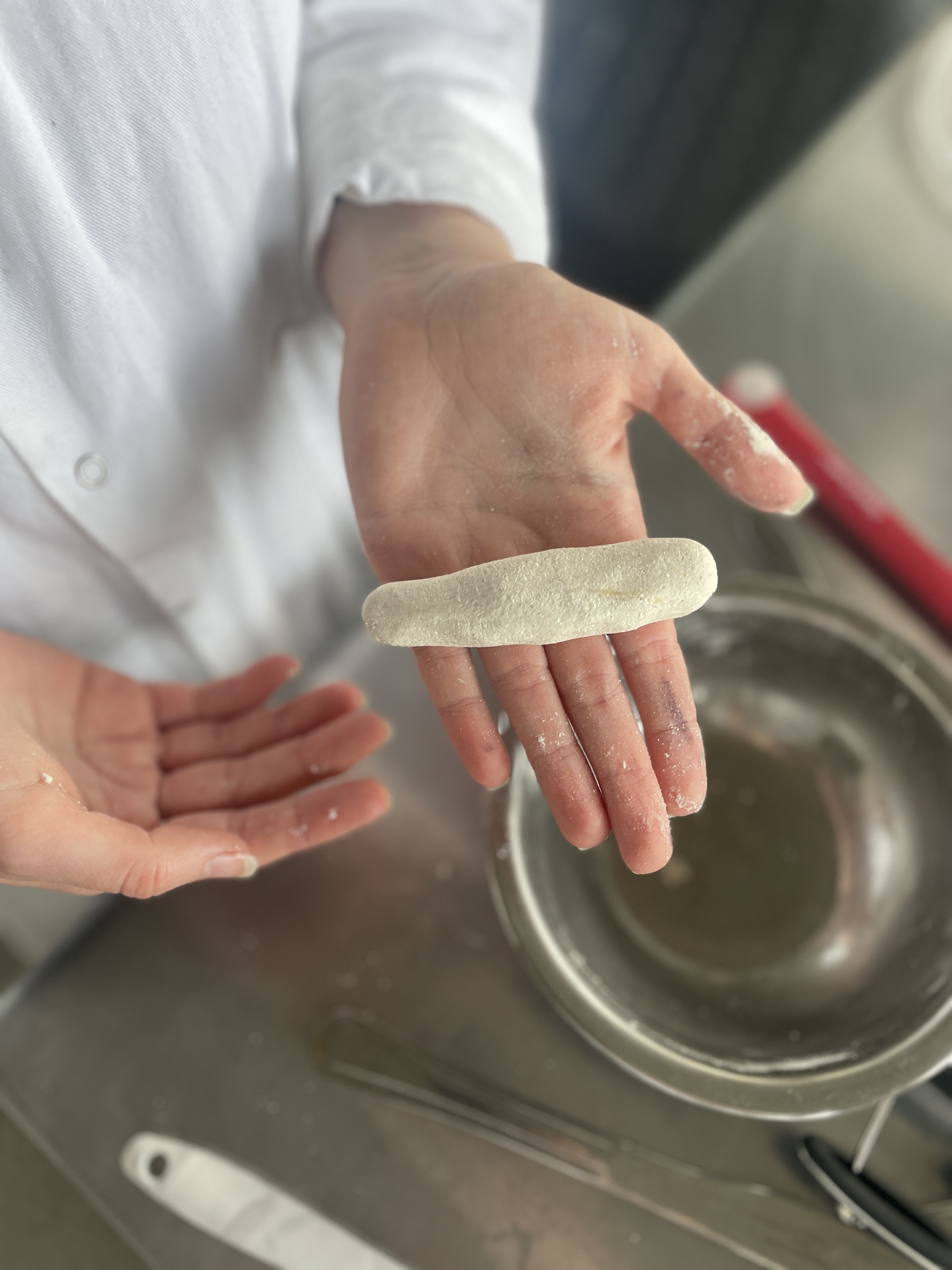
Over the last few months, we’ve made eggshell madeleines, chalk, rehydration and reuse attempts, laser cutting and engraving tests, and many, many warped sheets on our way to making a flat sheet–for the cover of a “menu” for sustainable signage options the gallery has produced. The base recipe we’ve been using, by Sofía Perales (via Materiom), does not include a plasticizer like glycerine, which results in a nice crispy surface, but one that tends to bend while drying, as if the eggshells want to return to their initial form. After wondering “how much should you listen to the material?” and “what does it want to do?” we added glycerine, which really helped the material settle down. This, along with a device we invented called “the cage” (aka two cookie drying racks sandwiching the material, clothespinned together), finally helped create a flat sheet of eggshell biocomposite.
Hannah Ferguson has been the Assistant Technician, Sustainability at the FOFA gallery since July 2024
 Speculative Life BioLab